Paper companion · He, Zhu & Mo · Nature Communications 2017
Lithium that moves together
How can five ions moving at once face a lower energy barrier than one ion moving alone?
A few solid electrolytes let lithium through almost as freely as a liquid does. Using quantum-mechanical simulations, the authors found that in these super-ionic conductors the ions rarely hop one at a time. Neighbouring ions hop together, and the energy barrier for that collective step is far lower than the crystal’s single-ion landscape would suggest.
The paper
The authors simulated three fast conductors, the sulfide LGPS, the garnet LLZO and the phosphate LATP, atom by atom at 300–1,500 K. The ions hopped in correlated groups, two to three at a time on average at 900 K. For one typical group in each material they then computed the lowest-energy route and its barrier.
What you’re looking at
One stretch of the garnet Li₇La₃Zr₂O₁₂. Lithium (green) sits in tetrahedral T sites, with four oxygen neighbours (yellow), or octahedral O sites, with six. The channel and viewpoint are rebuilt from the crystal structure and fitted to the paper’s own drawing. Ion motion between the start and end is interpolated, and the event coordinate is not time.
How to use it
Start with Figure 3, where the evidence is. Then scrub the event: five ions advance one site each while a marker runs along the paper’s energy curve. Compare one ion crossing alone, then test the paper’s simple model of why the group pays less.
Start with Figure 3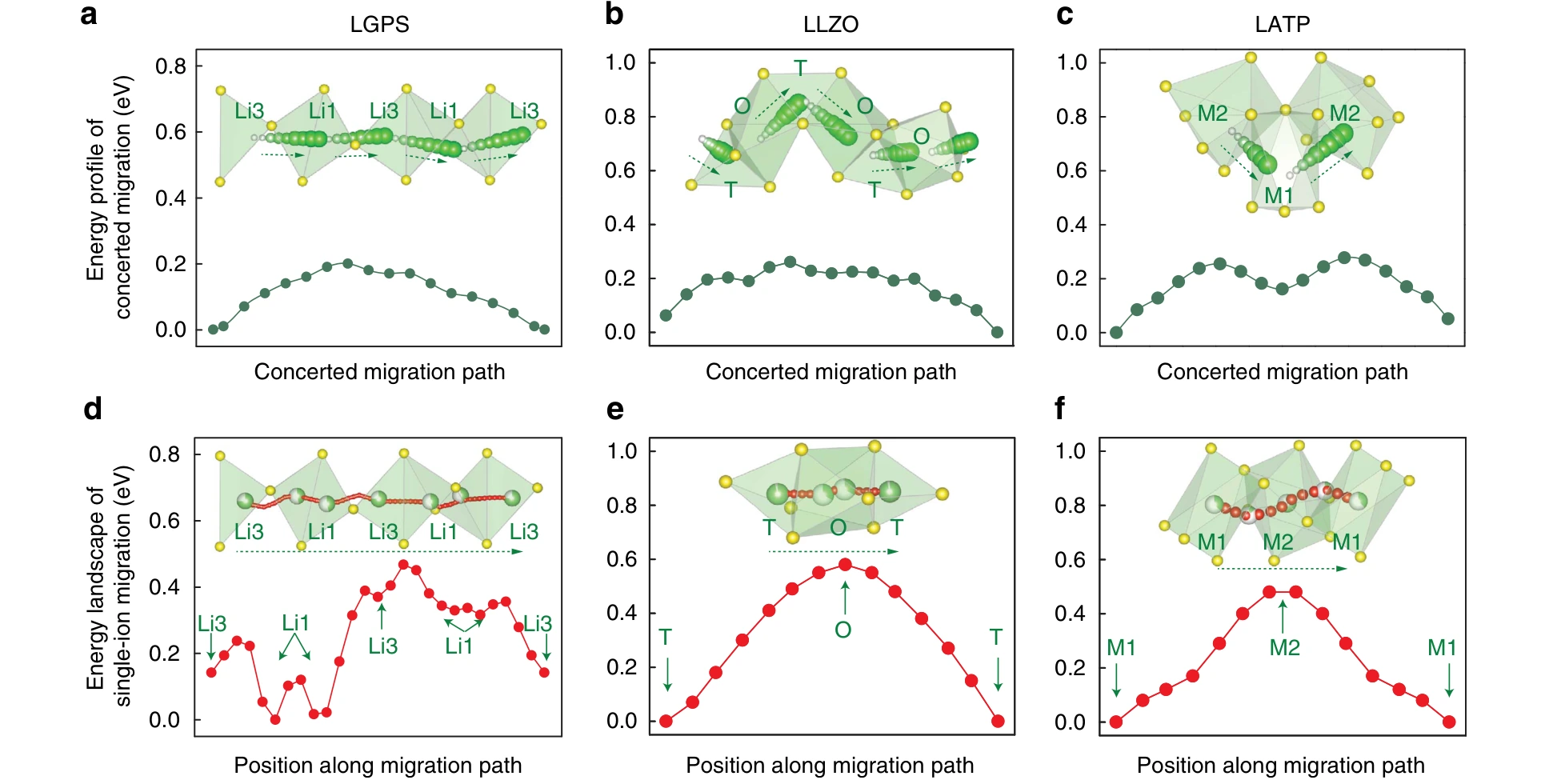
3D is unavailable in this browser. The figures, energy curves and explanations still work.
He, Zhu & Mo 2017 · Figure 3
The paper’s evidence: two energy curves
Event coordinate, start to end. Not time.
Compare with
Follow an ion
Show
View
The bar marks the range the paper plots, K = 2–6.5; beyond it the model is extrapolated. LLZO and LATP: the paper’s DFT estimates.
Framework landscape
Framework
Go deeper
The central idea
The landscape
is not
the whole story
A crystal’s framework sets an energy landscape: the energy of one lithium ion at each point along a channel. The classical picture says the highest point of that landscape is the barrier every ion must climb, 0.58 eV in LLZO.
But in these conductors there is more lithium than the low-energy sites can hold, so some ions sit on high-energy sites, pushed there by their neighbours. When a group moves together, those ions roll downhill while others climb, and their repulsion keeps the group spaced. The group’s barrier, 0.26 eV here, is lower than the landscape’s. The paper’s computed barriers agree with activation energies from its molecular dynamics and from experiments, but one event like this does not by itself set a material’s conductivity.
Source, interpretation & model
The source
Xingfeng He, Yizhou Zhu & Yifei Mo, Origin of fast ion diffusion in super-ionic conductors, Nature Communications 8, 15893 (2017).
Published paper ↗ · Author PDF ↗ · Supplementary information ↗
Figures © The Authors 2017, reproduced unchanged under CC BY 4.0 ↗. Energy points were read from the vector markers in the author PDF, to better than 0.01 eV.
What the model is
The garnet channel is rebuilt from the published space group of cubic LLZO. Its orientation is fitted to the oxygen positions drawn in Figure 3b’s inset, which it matches to 0.07 Å. The five ions’ start and end sites follow the paper’s description and that inset. Their straight-line motion is an interpolation, not the calculated path.
The 1D model is the paper’s own (Methods, eqs 6–8), re-run here. It reproduces Figure 4c and 4d to within 0.07 eV.
1Where it sits1 of 3
Two kinds of room for lithium
Tetrahedral T sites (four oxygens) and octahedral O sites (six) alternate along a chain that threads the garnet. Shown here is the moment the event begins, with five ions on this stretch of chain.
Framework
Rings mark sites; a sphere inside a ring is lithium. Faint rings are neighbouring sites off the channel, whose occupancy the paper does not show.
1Where it sits2 of 3
Shared, never all filled at once
Each cubic cell holds 56 lithium ions and 72 T and O sites. A T site and its neighbouring O site are only 1.99 Å apart, so they cannot both be filled at their centres. Averaged over time, every site is partly occupied. At any instant, each is either full or empty.
Show
The small green spheres stand for a time average, not for 72 ions. The paper’s Figure 2 draws the same idea as partially filled spheres.
1Where it sits3 of 3
One stretch of a three-dimensional network
The cubic cell is 12.98 Å on a side. Its T and O sites link into loops running in every direction, around the lavender zirconium ions. The bright line is the stretch the paper drew in Figure 3b.
View
This view shows connectivity only. One stretch of channel does not establish how well the network conducts over long distances.
2What moves1 of 2
Every ion advances one site
Three ions leave high-energy O sites for T sites while two leave T sites for O sites, all in one rearrangement. The paper’s calculated barrier for the whole group is 0.26 eV.
Start and end sites follow the paper and its Fig. 3b inset. The straight-line motion between them is interpolated, so neither the path nor the timing is the calculated one.
2What moves2 of 2
Alone, the same step costs 0.58 eV
Here one ion crosses from a T site, through an O site, to the next T site, with the rest of the lithium held fixed. It must climb to the O site, 0.58 eV above where it started. This is the framework’s energy landscape.
The paper removes one lithium ion and relaxes only the framework atoms for this curve, so the other lithium stays put. It is a reference landscape, not a competing event in the same crystal.
3Why it’s lower1 of 2
Downhill ions pay for uphill ones
Four ions sit on a line, two on low sites and two on the high sites between them, all repelling one another. When they shift together, the two on high sites fall while the other two climb, so much of the cost cancels.
In this model the energy is exactly the sum of the bars. The crystal’s DFT energy cannot be split per ion, so no such bars are drawn for LLZO.
3Why it’s lower2 of 2
If the high sites sit in a dip, all must climb
Give each high site its own 0.3 eV pocket and the picture changes: at the start every ion sits in a well, so the shift forces all four uphill at once. The group’s barrier rises far above the single-ion one.
The paper links this landscape to conductors that are not super-ionic, such as LiTiS₂ (Supplementary Note 4).